Opinion
When a LAW College Breaks the Law
The ILS fee controversy and a system in denial.

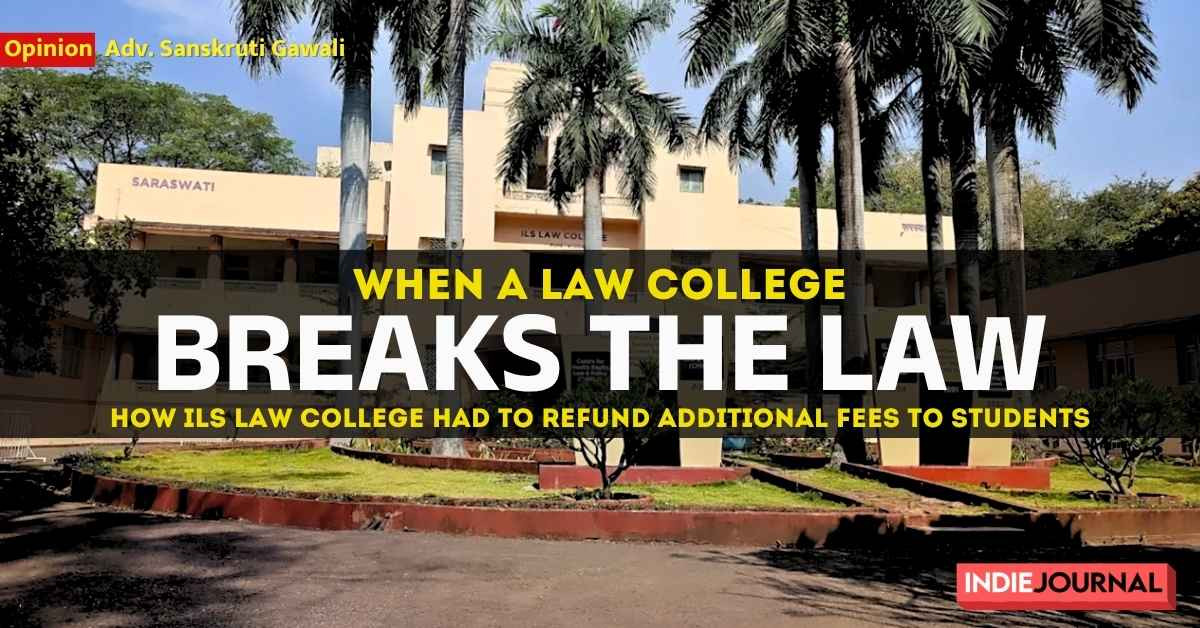
Sanskruti Gawali | What happens when institutions meant to impart the knowledge of law begin to operate outside it? The ongoing controversy at ILS Law College, Pune, raises precisely that question. What initially appeared to be a routine student grievance has now expanded into a full-blown institutional crisis. Hundreds of students, current and former, have sought refunds of fees now officially described by authorities as “illegally collected.” The scale of the response is telling: this is no longer about an isolated dispute, but about a pattern that went unchecked for years.
The facts are now difficult to contest. Acting on a complaint filed by a student, the Bombay High Court earlier this year directed the state’s Directorate of Higher Education (DHE) to examine allegations of excess fee collection. The inquiry that followed found that the college had levied charges under 'unapproved heads' that lacked statutory sanction. A refund of over Rs 1 lakh, along with interest, was ordered in the individual case that triggered the proceedings. Crucially, the inquiry also observed that similar refunds would be appropriate for other affected students.
That observation opened the floodgates. Within days, dozens and then hundreds of students began filing claims. Reports indicate that nearly 500 students attempted to submit refund applications in a matter of days. Many allege that such fees were collected annually under vague categories such as 'other activities', 'maintenance', or 'facilities' - labels that offer little clarity but significant room for discretion. For students and their families, these were not trivial amounts. Over the course of a degree, such charges could accumulate into a substantial financial burden.
"Students claim that such fees were collected repeatedly over multiple years."
At the heart of the issue lies a clear legal requirement. Under Section 101(7) of the Maharashtra Public Universities Act, 2016, affiliated colleges cannot independently introduce fee components. All fees must be approved by the university - in this case, Savitribai Phule Pune University (SPPU) - and must be transparently disclosed. The DHE’s findings suggest that this mandate was not followed. This is not a grey area. It is a straightforward question of legality.
Yet, what makes the episode deeply concerning is not just the violation itself, but the ecosystem that allowed it to persist. The alleged overcharging is not confined to a single academic year. Students claim that such fees were collected repeatedly over multiple years, in some cases between 2020 and 2025. If that is indeed the case, then the obvious question arises: where were the regulators? Universities exercise supervisory control over affiliated colleges. Fee structures are not meant to be a matter of institutional discretion. And yet, unapproved fee heads appear to have existed and been enforced without detection or intervention. It took an RTI application, a formal complaint and ultimately a writ petition before the issue received official attention. This points to a deeper structural flaw: regulation in higher education is often reactive rather than preventive. Violations are addressed only after they are exposed, rather than being detected through routine oversight. In such a system, compliance becomes contingent not on enforcement, but on the likelihood of challenge.
There is also a broader legal dimension that cannot be ignored. The collection of unauthorised fees raises questions of unjust enrichment: institutions cannot retain money collected without lawful authority. From a consumer protection standpoint, students who pay for educational services are entitled to transparency and fairness. Charges imposed without approval or clarity could well qualify as unfair trade practices. More fundamentally, arbitrary financial burdens have constitutional implications. Access to education, increasingly mediated by cost, cannot be subjected to opaque and unregulated fee structures. When institutions impose charges outside the framework of law, they risk undermining both equality and access. Any levy beyond the statutorily prescribed limits by an aided institution is not merely arbitrary; it is a blatant misappropriation of public trust and a violation of Article 14 (Right to Equality) and Article 21A (Right to Education) of the Constitution.
The consequences of this case extend beyond overcharging. They affect the functioning of public welfare schemes.
This principle is not new. In Unni Krishnan v. State of Andhra Pradesh, the Supreme Court held that institutions receiving public support assume a public character and cannot charge fees beyond what is lawfully permitted. Public funds, the Court emphasised, carry public obligations of fairness, transparency and compliance with constitutional guarantees. When institutions deviate from approved fee structures, they do not merely breach regulations; they act contrary to this settled constitutional principle.
The ILS episode also exposes the subtle ways in which opacity operates. The use of generic labels 'other fees', 'miscellaneous charges', 'activities' is not accidental. Such categories resist scrutiny precisely because they are undefined. They allow institutions to expand revenue streams without inviting immediate regulatory attention. For students, however, they translate into non-negotiable costs with little explanation. If this pattern is not addressed, it risks normalisation. Other institutions may adopt similar practices, confident that oversight is limited and consequences are delayed. Over time, this can transform the character of higher education from a regulated public good into a loosely supervised marketplace.
The consequences of this case extend beyond overcharging. They affect the functioning of public welfare schemes, particularly student scholarships. Under centrally sponsored schemes such as the Government of India Post-Matric Scholarship, financial assistance is provided to cover tuition fees and certain mandatory, approved institutional charges. The framework is structured: reimbursement is tied to recognised fee heads, as approved by competent authorities such as universities or regulatory bodies. It does not extend to arbitrary or unauthorised components introduced at the institutional level. This is where the distortion arises.
ILS students of law in Pune are struggling to get refund of excess fee. It reflects the kind of education being imbibed to future judiciary mechanism- just be money minded!
— For Of & By qualified People (Meritocracy) (@DammiVohra) April 23, 2026
When a college imposes additional, unapproved fee heads, students are still required to pay the full amount demanded. However, scholarship reimbursements remain limited to the approved portion typically tuition or admission-related fees. The excess amount, collected under undefined categories, falls outside the reimbursement framework. The result is a silent but significant shift in burden. Students who are ostensibly beneficiaries of state support end up paying substantial amounts out of pocket not because the scholarship is inadequate, but because institutional practices place part of the fee structure beyond its scope.
This creates an uneven playing field. Students enrolled in institutions that adhere strictly to approved fee structures are able to utilise the full benefit of scholarship schemes. In contrast, students at institutions imposing unauthorised charges effectively receive reduced support. The disparity is not policy-driven; it is institution-driven.
Illegal fee collection does not merely violate university regulations, it interferes with the effective delivery of public welfare schemes. It dilutes the purpose of scholarships designed to ensure equitable access to education. In effect, institutional opacity undermines state support.
The way forward lies not in isolated remedies, but in systemic correction. Every fee component should be clearly defined, publicly disclosed, and uniformly structured across institutions, so that students are not forced to rely on RTI applications simply to understand what they are paying for. At the same time, regulatory oversight must shift from being episodic to continuous. Universities and state authorities need robust mechanisms, both digital and audit-based, to monitor fee structures in real time, ensuring that approval processes are not only formal but also verifiable and enforceable.
This is not merely an institutional failure. It is a systemic one.
Equally important is the need to move beyond individualised remedies. If a fee is found to be illegal in one instance, it is unlikely to be lawful in others, requiring each student to independently seek relief only compounds the injustice. A class-wide approach to refunds would not only be more efficient but also more equitable. Finally, accountability must carry real consequences. Without meaningful penalties, whether financial or administrative, such violations risk being treated as manageable institutional practices rather than serious legal breaches.
The significance of the ILS controversy lies not in the amount of money involved, but in what it reveals about governance in higher education. Laws exist. Regulations exist. Oversight bodies exist. And yet, for years, an allegedly illegal fee structure appears to have operated in plain sight. This is not merely an institutional failure. It is a systemic one. Educational institutions occupy a position of trust. They are not just service providers; they are custodians of public confidence. When that trust is eroded, when students are compelled to question the legality of what they are charged, the damage extends beyond a single campus. The question, ultimately, is not whether one college complied with the law. It is whether the system ensures that compliance is unavoidable. Until that question is answered with conviction, controversies like this will not be an exception. They will be symptoms.
The author is a policy and research associate; Co-founder at Preamble Legal Chambers; and a former ILS Law College student (LL.B., Batch of 2024).



